RPM 101: A Provider's Guide to Remote Monitoring Revenue
Remote Patient Monitoring (RPM) can generate $100+ per patient per month — but many providers leave this revenue on the table. Here's everything you need to know about RPM billing, devices, and getting started.
Remote Patient Monitoring (RPM) is one of Medicare's fastest-growing programs — and for good reason. With reimbursement rates exceeding $100 per patient per month, RPM represents a significant revenue opportunity for practices serving Medicare beneficiaries.
Yet many providers either don't know about RPM or assume it's too complex to implement. This guide covers everything you need to know.
What Is Remote Patient Monitoring?
RPM is a Medicare-covered service that reimburses healthcare providers for monitoring patients' physiological data remotely using FDA-approved connected devices. Unlike telehealth visits, RPM doesn't require a real-time video consultation — it's based on the continuous collection and review of patient health data.
Common RPM use cases include:
- Blood pressure monitoring for hypertension
- Blood glucose monitoring for diabetes
- Weight monitoring for heart failure and obesity programs
- Pulse oximetry for COPD and respiratory conditions
- Temperature monitoring for post-surgical care
RPM CPT Codes and Reimbursement
RPM billing is built around three primary CPT codes:
| CPT Code | Description | Requirement | Reimbursement |
|---|---|---|---|
| 99454 | Device supply & daily data transmission | 16 days of data/month | ~$50/patient/month |
| 99457 | RPM management (first 20 min) | 20 min of monitoring/month | ~$50/patient/month |
| 99458 | RPM management (each add'l 20 min) | +20 min of monitoring/month | ~$40/patient/month |
With 30 RPM patients, that's $3,000–$4,200/month in recurring revenue — for time you may already be spending reviewing patient data.
RPM vs. CCM: What's the Difference?
Both RPM and CCM generate recurring monthly revenue, but they serve different purposes and can be billed together for the same patient:
| Feature | CCM (Chronic Care Management) | RPM (Remote Patient Monitoring) |
|---|---|---|
| Focus | Care coordination & care planning | Physiological data monitoring |
| Devices required | No | Yes (FDA-approved connected devices) |
| Min time/month | 20 min (standard) | 20 min (monitoring) |
| Patient eligibility | 2+ chronic conditions | Any chronic condition w/ monitoring need |
| Can bill together? | Yes — same patient, same month | Yes — same patient, same month |
Device Management: The Traditional Challenge
The biggest barrier to RPM adoption has been device management. Traditionally, practices needed to:
- Purchase devices — $50–$200 per device
- Set up connectivity — Cellular or Wi-Fi provisioning
- Train patients — Device setup and troubleshooting
- Manage inventory — Track which patient has which device
- Handle returns — When patients leave or devices break
This overhead made RPM impractical for smaller practices — the device costs often exceeded the first few months of reimbursement.
How iScript.care Removes the Barriers
iScript.care handles every aspect of RPM — from device procurement to billing:
Free Cellular Devices
We supply FDA-approved, cellular-connected devices at no cost to you or the patient:
- Blood pressure monitors
- Glucose meters
- Pulse oximeters
- Weight scales
- Thermometers
Devices are automatically provisioned and shipped to patients — no inventory management required.
Automatic Data Sync
All devices sync data automatically to the iScript platform. No patient action required — data flows continuously. The platform also includes automatic alert generation when readings fall outside configurable thresholds.
Integrated Monitoring Dashboard
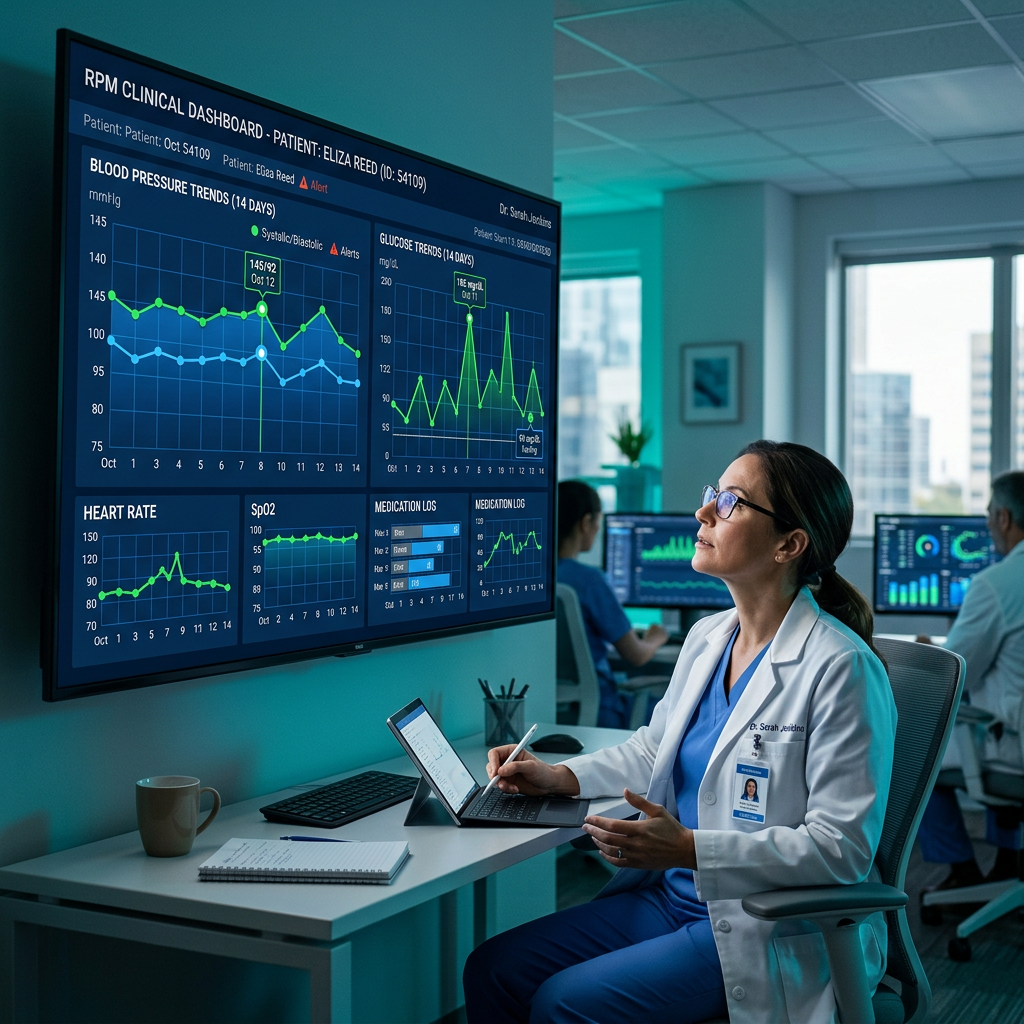
Your provider dashboard shows all patient device data in one place. Review readings, respond to alerts, and document monitoring time — all from the same interface you use for CCM, care plans, and patient communication.
Full Billing Management
We handle RPM billing end-to-end:
- Device supply billing (CPT 99454)
- Monitoring time tracking and billing (CPT 99457/99458)
- Claims submission and denial management
- Monthly ACH payouts
Vital Alert Rules
Configure custom alert thresholds for each patient:
- Blood pressure: critical high/warn high/normal/warn low/critical low (both systolic and diastolic)
- Glucose: configurable high/low thresholds
- Weight: delta alerts for sudden changes (critical for heart failure)
- Pulse oximetry: SpO2 thresholds
- Temperature: fever detection
Alerts can trigger SMS notifications to the care team, patient reminders, or automated task creation.
Getting Started with RPM
Starting an RPM program with iScript.care is straightforward:
- Apply to the Provider Network — 10-minute application
- Complete credentialing — ~5 business days
- Identify eligible patients — Any Medicare patient with a monitorable chronic condition
- Enroll patients & order devices — Devices ship directly to patients
- Start monitoring — Data flows automatically; review and respond to alerts
- Get paid — RPM billing begins with the first 16 days of data transmission
Most practices see their first RPM reimbursement within 30–45 days of patient enrollment. And since RPM is recurring monthly revenue, your RPM income grows steadily as you enroll more patients.
The Bottom Line
RPM is not a future opportunity — it's a current revenue stream that most practices are leaving on the table. With iScript.care, every barrier is removed: no device costs, no inventory management, no billing complexity. Just enroll patients, review their data, and earn recurring monthly revenue.
Combined with CCM, a single patient can generate $160–$250/month in additional revenue. A panel of 50 patients enrolled in both programs adds $8,000–$12,500/month — revenue you're not earning today.
Ready to start? Apply to the iScript Provider Network and activate RPM today.
Frequently Asked Questions
What is Remote Patient Monitoring (RPM)?
RPM is a Medicare-covered service that reimburses providers for monitoring patients' physiological data remotely using FDA-approved connected devices. Providers earn $100+ per patient per month for reviewing data and providing care management.
What are the RPM CPT codes?
Key RPM codes include: CPT 99454 (device supply and setup, ~$50/month), CPT 99457 (first 20 min of monitoring, ~$50/month), and CPT 99458 (each additional 20 min, ~$40/month). Total potential: $119+/patient/month.
Do I need to provide the devices?
With iScript.care, devices are provided at no cost to you or the patient. We supply FDA-approved cellular-connected devices (BP monitors, glucose meters, pulse oximeters, weight scales) that automatically sync data to the platform.
Which patients are eligible for RPM?
Any Medicare patient with a chronic condition that can be monitored remotely — hypertension, diabetes, heart failure, COPD, obesity, and more. Patients must consent and have a documented care plan.
Ready to Launch Your RPM / CCM Program?
iScript.care manages everything — clinical staff, devices, billing reports. You focus on your patients.