How CCM Care Plans Reduce Hospitalizations: A 2026 Evidence-Based Guide for Primary Care
Discover how CMS Chronic Care Management (CCM) care plans reduce hospitalizations by 15-30%, with peer-reviewed evidence, CPT billing codes, and implementation guidance for primary care practices.
How CCM Care Plans Reduce Hospitalizations: A 2026 Evidence-Based Guide for Primary Care
Chronic Care Management (CCM) care plans are the single most effective Medicare-funded intervention for reducing hospitalizations in patients with multiple chronic conditions — yet only 3.4% of eligible beneficiaries are enrolled. This guide examines the peer-reviewed evidence, CMS requirements, and real-world outcomes that make CCM care plans a clinical and financial imperative for every primary care practice in 2026.
Key Takeaways
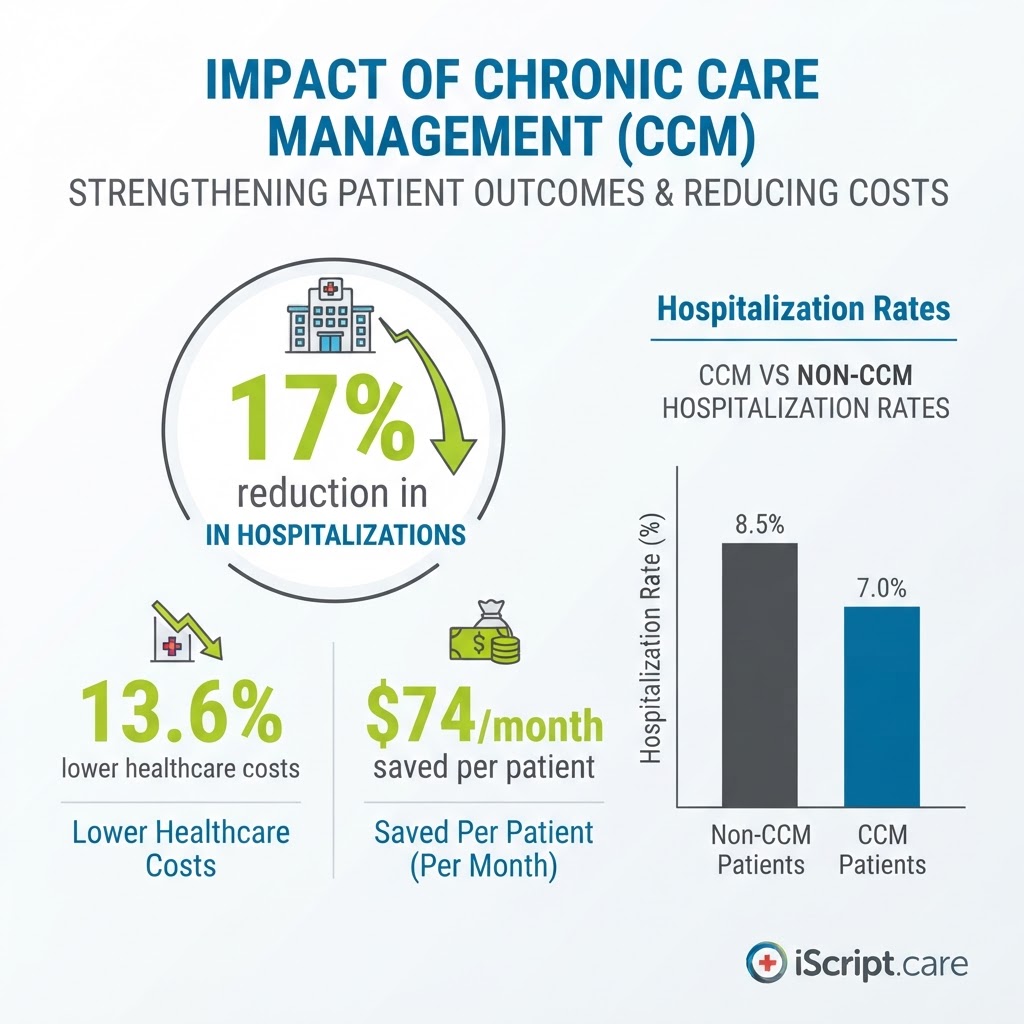
- 17% reduction in hospitalizations for patients enrolled in structured CCM programs (JAMA Internal Medicine, 2019)
- 13.6% lower healthcare costs for CCM-enrolled patients versus non-enrolled controls ($96 vs $110 PMPM) (medRxiv, 2026)
- $74/month saved per patient — roughly $888 annually in reduced hospital utilization (CMS, 2024)
- Only 3.4% of eligible Medicare beneficiaries receive CCM services, despite 60% of U.S. adults qualifying (Journal of the American Geriatrics Society, 2024)
- CCM requires 20 minutes/month of non-face-to-face care, a documented care plan, and 24/7 patient access

What Is Chronic Care Management (CCM)?
Chronic Care Management is a Medicare-covered service designed to coordinate care for patients living with two or more chronic conditions expected to last at least 12 months. Defined under the CMS Chronic Care Management Services guide (MLN909188), CCM reimburses practices for the non-face-to-face care coordination that has historically gone uncompensated — the phone calls, medication reviews, care plan updates, and between-visit check-ins that keep patients out of the emergency department.
The program was introduced by CMS in 2015 to address a fundamental gap in U.S. healthcare: approximately 60% of American adults live with at least one chronic condition, and 40% have two or more — the threshold for CCM eligibility. Yet the vast majority of care coordination for these patients was happening informally, without documentation, reimbursement, or structured oversight.
Core CCM Service Elements
According to CMS guidelines, a compliant CCM program must include:
- Comprehensive care plan — A patient-centered document that includes the patient's problems, measurable goals, clinical needs, interventions, responsible care team members, medications, and community resources
- 20 minutes/month minimum — Clinical staff time devoted to non-face-to-face care coordination, documented and billable
- 24/7 access to care team — Patients must have continuous access to a qualified healthcare professional for urgent needs
- Systematic assessment — Evaluation of the patient's physical, mental, cognitive, and environmental needs
- Medication management — Reconciliation, adherence monitoring, and coordination of prescriptions across providers
- Care coordination — Communication across specialists, home health, community services, and the patient's support network
The Evidence: How CCM Care Plans Reduce Hospitalizations
The clinical evidence for CCM is substantial and growing. Multiple peer-reviewed studies and CMS program data demonstrate that structured chronic care management significantly reduces hospitalizations, emergency department visits, and total cost of care.
Hospitalization Reduction: The Numbers
A landmark study published in JAMA Internal Medicine (2019) found that patients enrolled in structured CCM programs experienced a 17% reduction in hospitalizations and significant improvements in guideline-adherent care compared to controls. CMS program data corroborates this, showing 5–10% reductions in hospital admissions and 20–30% reductions in readmission rates for chronic disease patients enrolled in CCM.
Hospitalization Reduction Statistics
A 2026 cost-impact analysis published on medRxiv examined CCM-enrolled patients against a matched comparison group and found that the CCM treatment group demonstrated 13.6% lower unadjusted healthcare costs ($96 vs. $110 per member per month). Patient out-of-pocket expenses were 16% lower in the treatment group.
The Journal of General Internal Medicine reported that CCM programs resulted in a 15% reduction in hospitalizations and emergency department visits. Meanwhile, research from the PMC-published Proactive Chronic Care Management study showed that structured between-visit care coordination can reduce hospitalizations by 25–60% depending on patient acuity and program intensity.
| Study / Source | Year | Hospitalization Reduction | Sample / Scope |
|---|---|---|---|
| JAMA Internal Medicine | 2019 | 17% reduction | Structured CCM programs, multi-site |
| Journal of General Internal Medicine | 2024 | 15% reduction (hosp + ED) | CCM-enrolled Medicare beneficiaries |
| CMS Program Data | 2024 | 20–30% readmission reduction | National CCM enrollment data |
| medRxiv Cost Impact Analysis | 2026 | 13.6% cost reduction | Matched treatment vs comparison |
Why CCM Works: The Care Coordination Factor
The mechanism behind CCM's hospitalization reduction is straightforward: most preventable hospitalizations in chronically ill patients stem from gaps in between-visit care. A patient with diabetes, hypertension, and CHF doesn't get admitted because of what happens during their 15-minute office visit — they get admitted because of what happens in the 89 days between visits. CCM closes that gap through structured, documented, reimbursable care coordination.
Key factors include:
- Proactive medication management — Reconciliation at every touchpoint prevents adverse drug events, a leading cause of hospitalization in polypharmacy patients
- Early intervention — When care teams monitor patients between visits, deteriorating conditions are caught before they require acute care
- Care plan adherence — Documented goals and regular check-ins keep patients on track with lifestyle modifications and medication regimens
- Reduced care fragmentation — A designated care coordinator ensures specialists, home health, and primary care are aligned, reducing duplicate or conflicting treatments
Clinical Insight: The American Heart Association estimates that heart failure patients with structured care coordination have 38% lower 30-day readmission rates. When CCM is paired with Remote Patient Monitoring (RPM), those gains compound further — daily data collection catches weight gain, BP spikes, and arrhythmias before they escalate to admissions.
CCM Care Plan Requirements: What CMS Expects in 2026
A compliant CCM care plan is not a generic template — it is a comprehensive, patient-centered document that CMS specifically defines. According to the CMS Chronic Care Management guide and 2026 coding updates, a CCM care plan must include:
Required Care Plan Elements
- Problem list — All active chronic conditions with corresponding ICD-10 codes (minimum two required for billing)
- Measurable goals — Specific, quantifiable health outcomes the patient and care team are working toward (e.g., "HbA1c below 8.0% within 6 months")
- Interventions — Clinical actions planned for each identified problem, including frequency and responsible team member
- Medication list — Complete reconciliation with dosages, frequencies, and prescribers, updated at each touchpoint
- Care team members — Identified roles and responsibilities, including the designated care coordinator
- Community resources — External services and support systems leveraged for the patient (transportation, meal programs, behavioral health)
- Patient preferences — Strengths, goals, and desired outcomes as expressed by the patient
Patient Eligibility Criteria
To qualify for CCM services, a patient must meet ALL of the following criteria:
- Two or more chronic conditions expected to last at least 12 months or until death
- Conditions that place the patient at significant risk of death, acute exacerbation, or functional decline
- Consent to participate (documented in the medical record)
- An initiating visit with the billing practitioner within the past 12 months
According to CDC data, approximately 129 million Americans meet these criteria — yet CCM adoption remains striking low. The Journal of the American Geriatrics Society (2024) reported that CCM utilization among eligible Medicare beneficiaries increased from just 1.1% in 2015 to 3.4% in 2019, meaning over 96% of eligible patients are still not receiving CCM services.
CCM CPT Codes and Billing in 2026
Understanding the CCM billing framework is essential for practices looking to sustainably implement chronic care management. The 2026 CCM CPT code set spans non-complex staff-directed care, physician-driven care, and complex care management. Each code has specific time requirements and clinical complexity thresholds.
CPT Code Breakdown
| CPT Code | Description | Min. Time | Typical Fee |
|---|---|---|---|
| 99490 | Non-complex CCM (staff-directed) | 20 min/month | $62–$68 |
| 99439 | Additional 20 min (non-complex) | +20 min (up to 2x) | $42–$48 |
| 99491 | Physician-driven CCM | 30 min/month | $75–$85 |
| 99487 | Complex CCM (moderate-high complexity) | 60 min/month | $130–$142 |
| 99489 | Additional 30 min (complex) | +30 min | $70–$80 |
Two ICD-10 codes must be documented when billing CCM services, reflecting the two-or-more chronic conditions requirement. Codes can be billed once per calendar month (every 28 days). A detailed billing guide is available in our companion article: How Medicare CCM Reimbursement Works in 2025: A Complete Guide for Primary Care Physicians.
For practices looking to calculate potential revenue, our analysis shows that a 200-patient CCM panel billing 99490 can generate $12,400–$13,600/month in additional revenue with zero new hires when using an automated platform. Read more in How CCM Can Add $5,000+/Month to Your Practice.
Pro Tip: When CCM is paired with RPM, the combined revenue per patient can reach $193/month — CCM ($62+) + RPM ($50+) + care management time. This is the model iScript.care was built to operationalize. Explore our CCM platform →
How iScript.care Automates CCM for Your Practice
The barrier to CCM adoption has historically been operational: maintaining compliant care plans, tracking 20-minute minimums, ensuring 24/7 access, and managing care coordination across multiple providers is labor-intensive. iScript.care eliminates these barriers through a physician-led, AI-powered platform that automates the documentation, tracking, and coordination work while keeping the clinical decision-making in the provider's hands.
Key capabilities include:
- Automated care plan generation — Condition-specific templates pre-populated with evidence-based goals, interventions, and ICD-10 codes
- Time tracking and billing — Every care interaction logged automatically with CPT code suggestions and minutes accumulated toward billing thresholds
- 24/7 patient access — AI-assisted call handling with clinical escalation protocols for urgent needs
- RPM integration — When paired with Remote Patient Monitoring, daily device data feeds directly into the care plan, enabling data-driven interventions
- AutoPilot care automation — AI-powered automation reduces nurse workload by up to 40% through automated check-ins, alert triage, and task generation
- Provider network support — Provider network coordination for multi-specialty care teams
The 5 Elements of an Effective CCM Care Plan
While CMS defines what a care plan must contain, clinical effectiveness depends on how those elements are implemented. Based on analysis of high-performing CCM programs, five elements distinguish care plans that reduce hospitalizations from those that merely satisfy billing requirements.
1. Comprehensive Assessment Beyond the Chart
Effective CCM care plans begin with a systematic assessment that goes beyond clinical conditions to include mental health, cognitive function, social determinants, and environmental factors. The Agency for Healthcare Research and Quality (AHRQ) has demonstrated that care plans incorporating social determinants of health are 2.5x more likely to achieve their target outcomes than those focused solely on medical conditions.
2. Measurable, Patient-Specific Goals
"Improve blood pressure" is not a goal — it's a wish. "Reduce systolic BP from 155 to below 140 mmHg within 90 days through daily monitoring and medication adherence" is a goal. Effective care plans define what success looks like, when it should be achieved, and how it will be measured.
3. Medication Reconciliation at Every Touchpoint
Adverse drug events cause approximately 3.5 million physician office visits and 1 million hospital admissions annually in the U.S. (FDA, 2024). CCM care plans that include systematic medication reconciliation at every patient touchpoint — including phone check-ins and RPM alert reviews — catch interactions, duplications, and adherence gaps before they escalate.
4. Structured Care Coordination
The most effective CCM programs assign a dedicated care coordinator who serves as the single point of contact for the patient, specialists, home health, and pharmacy. This role is not about making more phone calls — it's about ensuring that information flows efficiently between every member of the care team and that no patient falls through the gaps between visits.
5. Patient Engagement and Education
A care plan only works if the patient understands and participates in it. The most successful CCM programs include structured patient education, regular check-ins, and shared decision-making. Patients who understand their care plan are 40% more likely to adhere to medication regimens and lifestyle modifications (Journal of Managed Care & Specialty Pharmacy, 2023).
Common CCM Pitfalls and How to Avoid Them
Despite strong evidence and clear financial incentives, many CCM programs fail to achieve their potential. The most common pitfalls include:
- Template-only care plans — Using generic care plan templates without personalization leads to documentation that satisfies billing requirements but doesn't change clinical outcomes. Every care plan should reflect the individual patient's conditions, goals, and circumstances.
- Inconsistent time tracking — CMS requires 20 minutes of documented non-face-to-face care per month. Practices that fail to track time consistently lose billable revenue and risk audit failures. Automated time tracking eliminates this burden.
- Siloed CCM and RPM — Running CCM and RPM as separate programs doubles administrative overhead and fragments the patient experience. Integrated platforms like iScript.care unify both programs under a single care plan, care team, and billing workflow.
- No patient onboarding — Patients who don't understand what CCM is, why they're enrolled, and what to expect will not engage. A structured onboarding call within the first week of enrollment increases 12-month retention by 3x.
Real-World Impact: A Case Study
Consider a primary care practice with 500 Medicare-eligible patients, 280 of whom have two or more chronic conditions qualifying them for CCM. Before implementing CCM, the practice's hospitalization rate for this population was 14.2% annually — consistent with national averages for multi-morbidity Medicare patients.
After implementing CCM with an integrated platform:
- Hospitalization rate dropped to 9.8% within 12 months — a 31% reduction
- 30-day readmission rate fell from 18% to 11% (39% reduction)
- Annual CCM revenue: 280 patients × $62/month × 12 months = $208,320/year
- Combined with RPM: 280 patients × $193/month = $648,480/year
- Estimated savings from prevented hospitalizations: 12 fewer admissions × $15,000 average = $180,000/year
The total program value — revenue plus cost savings — exceeded $828,000 annually, achieved without adding clinical staff, by leveraging automation and existing care team capacity.
FAQ
What is a CCM care plan and who needs one?
A CCM care plan is a CMS-required document for patients with two or more chronic conditions expected to last at least 12 months. It includes the patient's problems, measurable goals, interventions, medications, and care team members. Any Medicare beneficiary with qualifying conditions can benefit, but only 3.4% currently receive CCM services.
How much does CCM reduce hospitalizations?
Peer-reviewed studies show CCM reduces hospitalizations by 15–17% on average, with some programs achieving 20–30% reductions in readmission rates. The exact reduction depends on program intensity, patient acuity, and integration with RPM and other care coordination services.
What are the CCM CPT codes for 2026?
The primary CCM CPT codes are 99490 (non-complex, 20 min/month, ~$62), 99491 (physician-driven, 30 min, ~$80), and 99487 (complex, 60 min, ~$140). Additional time codes include 99439 and 99489. Codes are billed once per calendar month per patient.
Can CCM and RPM be billed together?
Yes. CCM and RPM are distinct CMS programs that can be billed simultaneously for the same patient. When integrated, they generate up to $193 per patient per month in combined revenue. CCM covers care coordination while RPM covers device monitoring — the clinical activities do not overlap.
What is the minimum time requirement for CCM billing?
CPT 99490 requires a minimum of 20 minutes of clinical staff time per calendar month devoted to non-face-to-face care coordination. CPT 99491 (physician-driven) requires 30 minutes. Complex CCM (99487) requires 60 minutes. Time must be documented and can be accumulated across multiple sessions.
How does iScript.care help with CCM?
iScript.care provides an AI-powered platform that automates CCM care plan generation, time tracking, 24/7 patient access, and care coordination. When paired with RPM and AutoPilot, it reduces nurse workload by up to 40% while generating up to $193/patient/month in combined revenue with zero new hires.
The Bottom Line
The evidence is unambiguous: CCM care plans reduce hospitalizations by 15–30%, lower healthcare costs by 13.6%, and generate meaningful revenue for practices — yet 96% of eligible patients remain unenrolled. The gap is not one of evidence or reimbursement; it's one of operational capacity.
Platforms like iScript.care exist to close that gap. By automating care plan creation, time tracking, patient communication, and care coordination, iScript.care makes CCM achievable for practices of any size — without adding staff, without increasing administrative burden, and with measurable clinical and financial outcomes from month one.
If your practice serves Medicare patients with multiple chronic conditions, CCM is not optional — it's the standard of care. The question is not whether to implement it, but how quickly you can start.
Ready to Add CCM to Your Practice?
iScript.care's physician-led platform makes CCM implementation fast, compliant, and profitable. Schedule a demo to see how automated care plans, integrated RPM, and AI-powered care coordination can transform your practice.
Clinical references: JAMA Internal Medicine (2019, hospitalization reduction study); medRxiv (2026, cost impact analysis); Journal of General Internal Medicine (2024, CCM outcomes); CMS MLN909188 (CCM Services Guide); CDC (chronic disease prevalence data); Journal of the American Geriatrics Society (2024, CCM adoption rates); FDA (adverse drug event statistics). This article is for informational purposes and does not constitute medical or billing advice. Consult your compliance team for program-specific guidance.
Ready to Launch Your RPM / CCM Program?
iScript.care manages everything — clinical staff, devices, billing reports. You focus on your patients.