Medicare dollar amounts in older articles are not current. Calendar year 2026 national non-facility amounts are on the chronic care page. This article is not a quote of what a practice will be paid.
Is Your RPM Platform Smart Enough? The Role of AI and Advanced Tech in Modern Chronic Care
AI is no longer a buzzword in healthcare — it's redefining what's possible in remote patient monitoring. From predictive deterioration alerts to automated EHR documentation, discover what a truly intelligent RPM platform looks like.
Technology is rapidly reshaping the delivery of healthcare, and in chronic disease management, advancements in Artificial Intelligence and cellular connectivity are proving to be game-changers. For Primary Care Physicians, embracing these innovations in RPM and CCM is key to providing more proactive, personalized, and efficient care.
AI: Transforming Remote Care from Reactive to Predictive
Artificial intelligence has moved beyond buzzword status in healthcare. It is now a core component of next-generation RPM platforms — and practices that leverage it gain a significant clinical and competitive advantage.
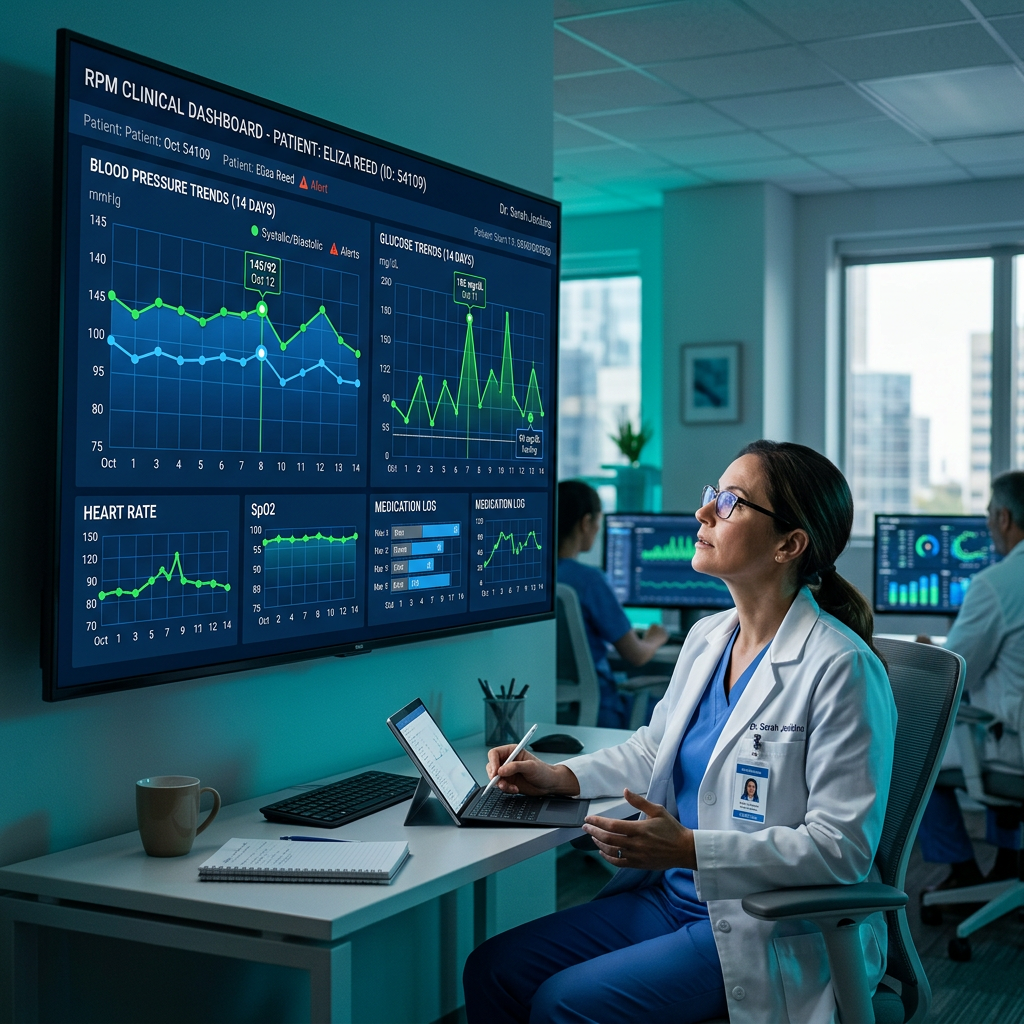
Intelligent Early Warning Systems AI algorithms analyze vast amounts of RPM device data to identify subtle patterns indicating patient deterioration — often days before overt symptoms appear. This enables proactive intervention, potentially preventing hospitalizations and acute events that are costly for patients and the healthcare system.
Example: An AI model detecting a 3-day trend of rising resting heart rate combined with subtle weight gain in a CHF patient — triggering a care manager call before the patient calls 911.
Refining Diagnostics and Personalizing Treatment AI's analytical power assists in refining diagnostic processes, personalizing treatment plans, and identifying gaps in care that manual data review misses. This is particularly valuable for patients on complex medication regimens or with multiple comorbidities.
Improving Clinical Efficiency AI-driven tools automate tasks like summarizing patient data trends and integrating information directly into EHRs — reducing administrative burden on clinical staff and freeing time for direct patient care and clinical decision-making.
Connectivity: Making RPM Accessible for All Patients
The effectiveness of RPM hinges on consistent patient adherence — which is significantly impacted by ease of use and device connectivity. Modern RPM technology is focused on breaking down barriers.
Cellular Connectivity: The Standard of Care Devices with built-in cellular chips transmit data automatically without requiring smartphones or home Wi-Fi. This is crucial for reaching patients in rural areas or those with limited technological access — promoting health equity while maximizing billable adherence.
- 30% of Medicare patients lack home Wi-Fi access
- Cellular devices achieve 27% higher CPT 99454 eligibility than Wi-Fi-dependent devices
- No app, no Bluetooth pairing, no patient tech support required
"Plug-and-Play" Simplicity The emphasis in modern RPM device design is on pre-configured, zero-setup devices. Patients receive a device ready to use out of the box — press one button, data transmits. This simplicity drives the adherence that makes programs financially viable.
What an Intelligent RPM Platform Looks Like in 2025
A modern, AI-enhanced RPM platform should deliver:
| Feature | Basic Platform | Intelligent Platform | |---------|---------------|---------------------| | Data collection | ✓ | ✓ | | Alert thresholds | Static rules | AI-adaptive thresholds | | Trend analysis | Manual review | Automated trend detection | | EHR documentation | Manual entry | Auto-generated notes | | Deterioration prediction | None | Days-in-advance alerts | | Billing compliance | Report export | Auto time-tracking + reports | | Care plan guidance | Template-based | Dynamic, data-informed | | Alert fatigue | High | 60% fewer false positives |
iScript.care: Leading with Intelligent and Accessible Technology
Doctor-Led Approach to Technology Integration Our service is led by Dr. Chomba Chuma, MD, with specialized training in Medical Informatics. This ensures our technology platform is designed with a deep understanding of clinical workflows — we prioritize technology that is not only advanced but clinically relevant and practically usable.
Doctor-Designed Care Plans Powered by Technology Our care managers follow Doctor-Designed Care Plans. Our platform facilitates implementation and monitoring of these plans — using data and AI-driven insights to guide care managers and flag potential issues. Technology supports, rather than complicates, the delivery of physician-directed care.
Accessible Devices with Cellular Connectivity We prioritize RPM devices that are user-friendly, pre-configured, and feature reliable cellular connectivity — maximizing adherence, clinical data quality, and billable day counts across your patient population.
The Bottom Line for Primary Care Practices
Practices that embrace AI-enhanced RPM platforms in 2025 will:
- Detect deterioration earlier — fewer hospitalizations, better outcomes
- Reduce administrative burden — AI documentation and auto-reporting
- Increase billable adherence — cellular devices and smart alerts
- Differentiate their practice — proactive chronic care as a competitive advantage
Conclusion
The integration of AI and advanced cellular connectivity is revolutionizing remote patient monitoring — transforming it into a proactive, predictive, and more efficient tool for chronic disease management. To fully leverage these advancements, PCPs need a technology partner that understands both clinical and technical aspects of remote care. iScript.care, with our Doctor-Led expertise and Doctor-Designed Care Plans supported by intelligent technology, is uniquely positioned to help your practice harness these innovations for better patient outcomes and a more streamlined workflow.
If this fits your practice, apply and we will call you.
$34.95 per enrolled patient per programme, or $55.00 for two. Invoiced monthly in arrears; due within 45 days. The practice bills Medicare under its own NPI.